Fully Adhered Single Ply
A smooth, bonded finish for visible and exposed roofs.
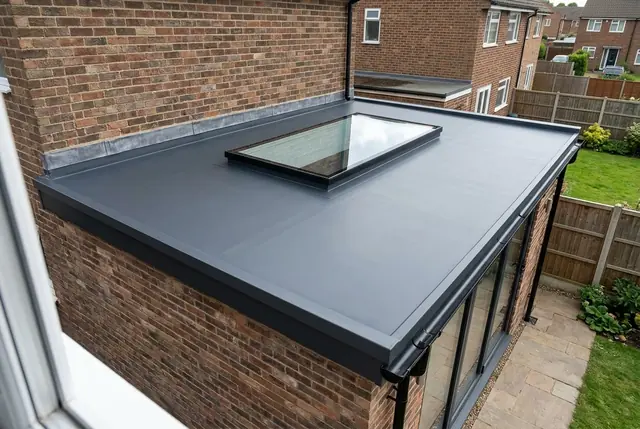
A fully adhered single ply roof has a fleece-backed membrane bonded to the insulation or deck with adhesive across its whole area. It gives a smooth, taut finish with no visible fixing lines and performs well in high wind zones.
How does fully adhered single ply roofing work?
Adhered single ply is glued rather than screwed. A fleece on the back of the sheet beds into polyurethane or contact adhesive, so the roof looks flat and clean, which is why it is chosen for overlooked extensions and terraces.
Adhesives need a dry substrate and a minimum temperature, usually around 5°C, so programme depends more on weather than with mechanical fixing. Insulation boards are bonded or fixed first and must be compatible with the adhesive chosen.
What is included?
- Fleece-backed PVC or TPO membrane
- Polyurethane or contact adhesive matched to the substrate
- Bonded insulation boards with tissue or foil facings as required
- Smooth, ripple-free finish for visible roofs
- No fixing penetrations through the deck
- Good acoustic performance in wind
- Perimeter restraint at all edges and upstands
- Adhesion checks on trial areas before full application
How much does fully adhered single ply roofing cost?
£95–£145 per m², plus VAT. This is a 2026 UK guide range; London and the South East sit towards the top and large simple roofs towards the bottom. A survey fixes the price for your roof.
Get a guide price for your roof
When is it the right choice?
Full bonding spreads wind load across the whole membrane instead of concentrating it at fasteners. It suits concrete decks, complex shapes and roofs where a neat appearance or a quiet interior matters.
Questions about fully adhered single ply roofing
What is a fully adhered roof?
It is a single ply roof where the membrane is glued to the layer beneath across its whole surface, rather than fastened with screws or weighed down by ballast.
Is adhered better than mechanically fixed?
Neither is better in every case. Adhered roofs look smoother and are quiet in wind; mechanically fixed roofs go down faster and tolerate poor weather. The deck, exposure and budget decide.
Can adhesive be used in cold weather?
Most roofing adhesives need the surface to be dry and at or above about 5°C. Below that, work pauses or switches to a mechanically fixed or induction-welded method.
Why does the membrane have a fleece back?
The fleece gives the adhesive something to grip and separates the membrane from materials it should not touch, such as bitumen under PVC.
Does a bonded roof cost more?
Usually a little, because fleece-backed membrane and adhesive cost more than fasteners and labour is slower. Expect roughly £10 to £20 per m² extra.
Where do we provide fully adhered single ply roofing?
Across the UK. Choose an area for local guide prices.
- Central London
- North London
- South London
- East London
- West London
- Kent
- Surrey
- Sussex
- Hampshire
- Berkshire
- Oxfordshire
- Buckinghamshire
- Essex
- Hertfordshire
- Bedfordshire
- Cambridgeshire
- Norfolk
- Suffolk
- Bristol
- Somerset
- Gloucestershire
- Wiltshire
- Dorset
- Devon
- Cornwall
- Birmingham
- Black Country
- Coventry and Warwickshire
- Staffordshire
- Worcestershire
- Shropshire
- Herefordshire
- Nottinghamshire
- Derbyshire
- Leicestershire
- Northamptonshire
- Lincolnshire
- West Yorkshire
- South Yorkshire
- North Yorkshire
- East Yorkshire
- Greater Manchester
- Merseyside
- Lancashire
- Cheshire
- Cumbria
- Tyne and Wear
- County Durham
- Teesside
- Northumberland
- Cardiff and the Vale
- Swansea and West Wales
- Newport and Gwent
- South Wales Valleys
- North Wales
- Glasgow and Clyde
- Edinburgh and the Lothians
- Lanarkshire
- Ayrshire
- Fife
- Tayside
- Aberdeen and Grampian
- Highlands
- Central Scotland
- Belfast
- County Antrim
- County Down
- Derry and the North West
- Armagh and Mid Ulster
Related services
Ready to price your roof?
Get a guide price in under a minute, or ask for a free survey and a fixed written quotation.